
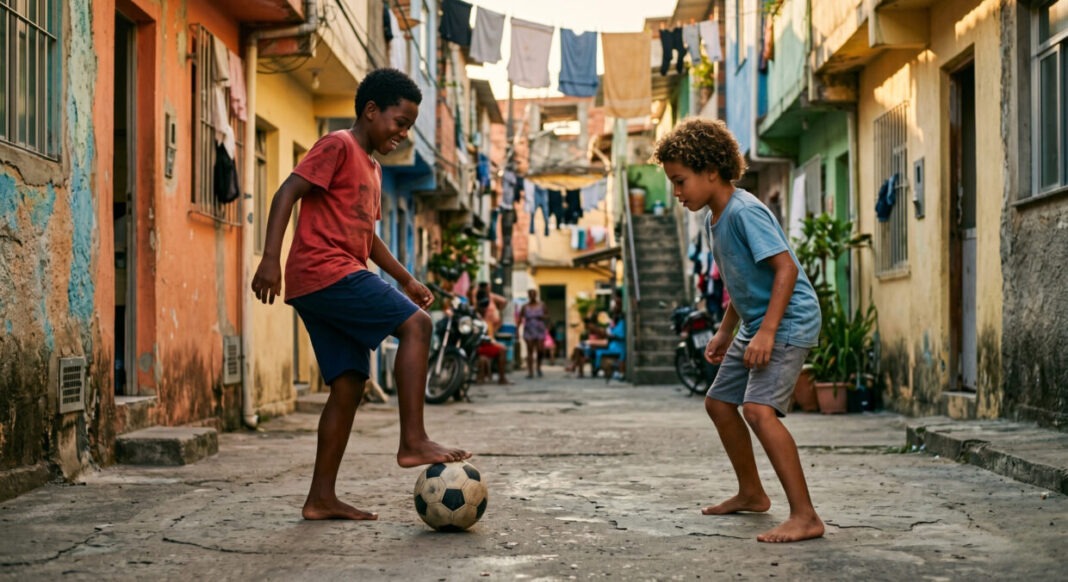
There’s a scene every foreign coach knows, even if they’ve never set foot in Brazil. A boy gets the ball, finds the tightest possible space, and instead of shooting or passing right away, he decides to dribble. Not because he has to. Because he can.
Almost no European school coach teaches that. Most of them ban it. In Brazil, that boy is the standard. As the World Cup returns to the Americas in 2026, that difference is worth understanding. And understanding why says something about this country that goes far beyond football.
The street before the pitch
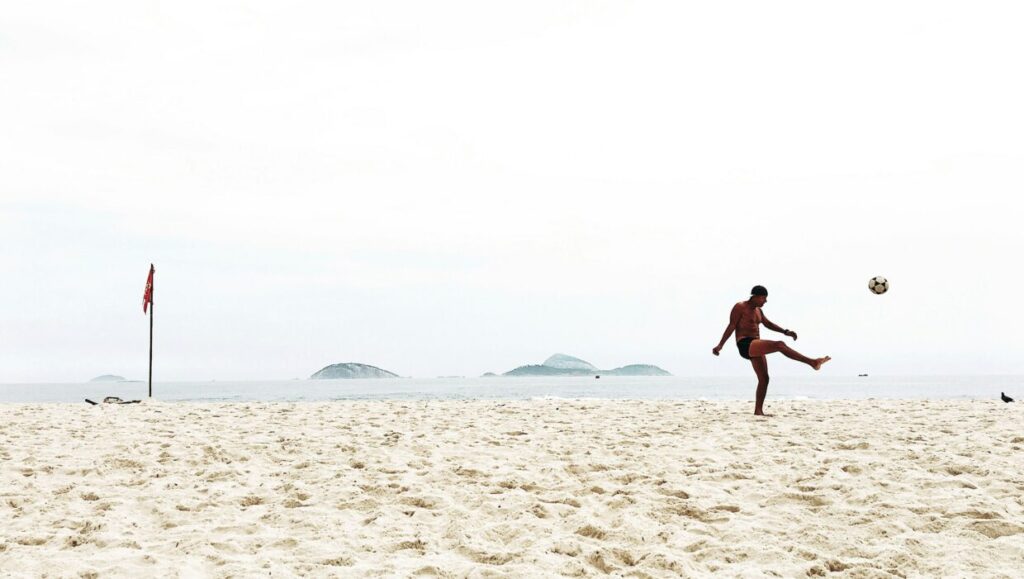
Football arrived in Brazil in the late nineteenth century, brought by Charles Miller, the son of a Scottish immigrant raised in São Paulo. It was a sport for the elite — played in private clubs, with strict rules and a clear European aesthetic: discipline, organization, efficiency. That didn’t last long. Football stopped being an elite sport faster than any other sport in the country’s history.
On the beaches, on unpaved streets, in the cramped backyards of working-class neighborhoods, the game changed. No referee, no sideline, no clock. It developed different rules — invisible ones, but far more demanding. You had to be good to stay in the game. You had to have style to be respected. And “style,” in Brazil, never just meant efficiency. It meant something harder to name, something closer to grace.
The dribble is not a tactical tool in Brazilian football. It’s a statement of intent. It’s telling your opponent: I could have taken the easy way, but I chose to go through you.
What anthropology helps explain
Roberto DaMatta, one of Brazil’s most influential anthropologists, spent decades studying football as a cultural phenomenon. For him, the pitch is one of the few spaces in Brazil where social hierarchy — which organizes nearly everything outside of it — gets temporarily suspended. Inside those four lines, what matters is ability, not last name.
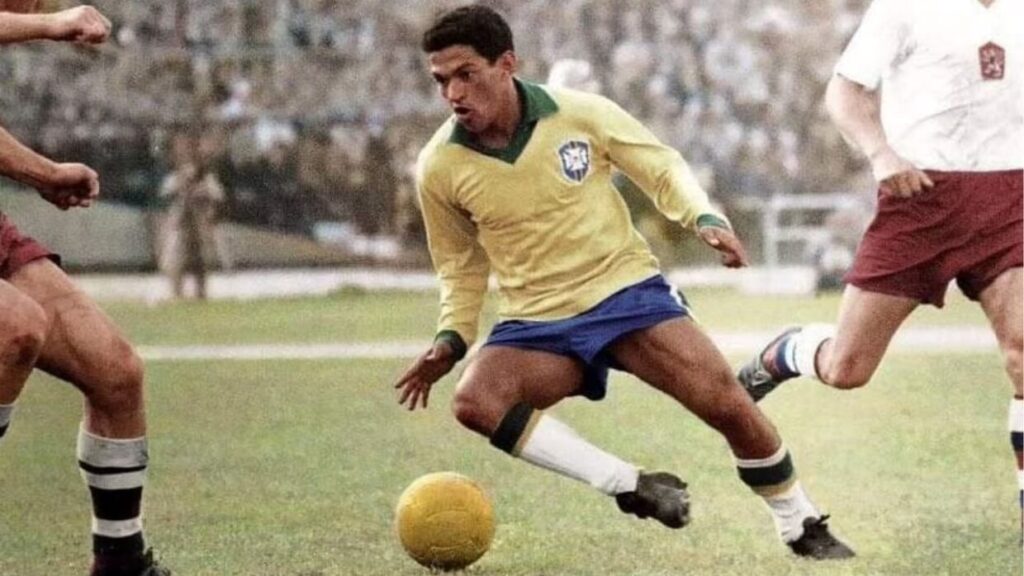
That created something specific. Football became one of the few places where a boy from Pau Grande, a small town in the interior of Rio de Janeiro, born with legs curved by a congenital condition, could be recognized as the best player in the world. And he was. His name was Garrincha.
This isn’t nostalgia. It’s structure. Brazilian football works as a release valve in a social system that, outside the pitch, offers very few of those openings. That’s why the country lives the sport with such intensity. And it partly explains why the talent that comes out of here is so different: it carries more weight, more urgency, more need to prove itself.
“Beautiful game” is not just a romantic idea
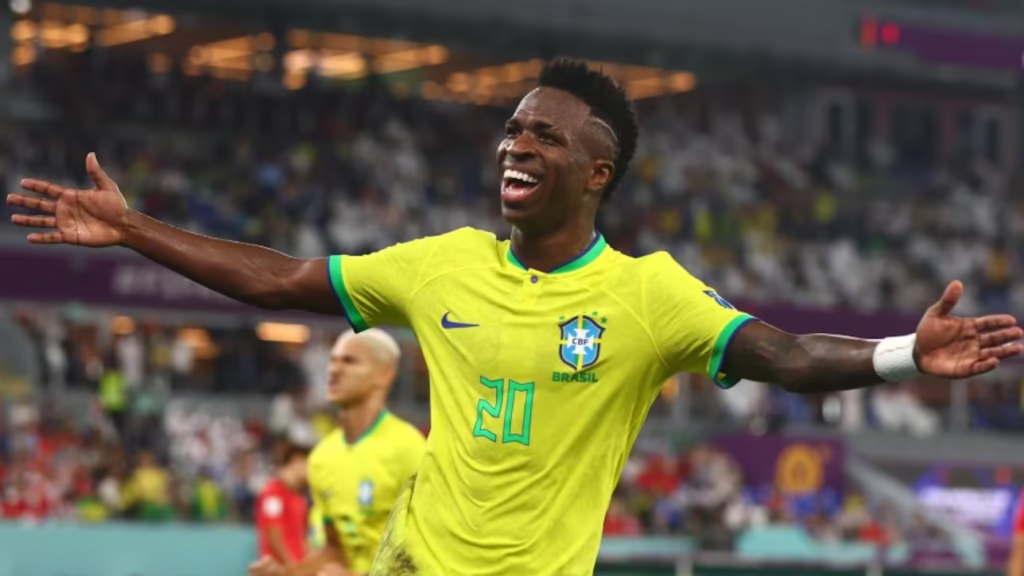
There’s an easy trap when talking about Brazilian football to foreign audiences: turning everything into poetry. The jogo bonito, the samba footwork, the ginga. These are real expressions, but when they become clichés, they stop explaining anything.
What actually happens is more concrete.
For decades, Brazilian football developed players in an environment where space is always tight and the opponent is always older. Street football has no sidelines. The beach has no firm grass. The dirt field in the neighborhood has rocks in the middle. Those physical conditions created specific physical skills: ball control on uneven surfaces, dribbling in minimal space, sharp peripheral vision to read the game when you can’t afford to look up.
Jonathan Wilson, in his book Inverting the Pyramid, describes how Brazilian football consciously moved away from the English direct-play model as early as the 1930s, when European coaches still dominated the global game. The bet was on a shorter, more technical style — individual brilliance within a collective structure. By 1958, that bet had become a World Cup title.
What the world calls “magic” is, in practice, decades of development in an environment where the right way to play was never the easiest or most conventional one.
What this reveals about Brazil
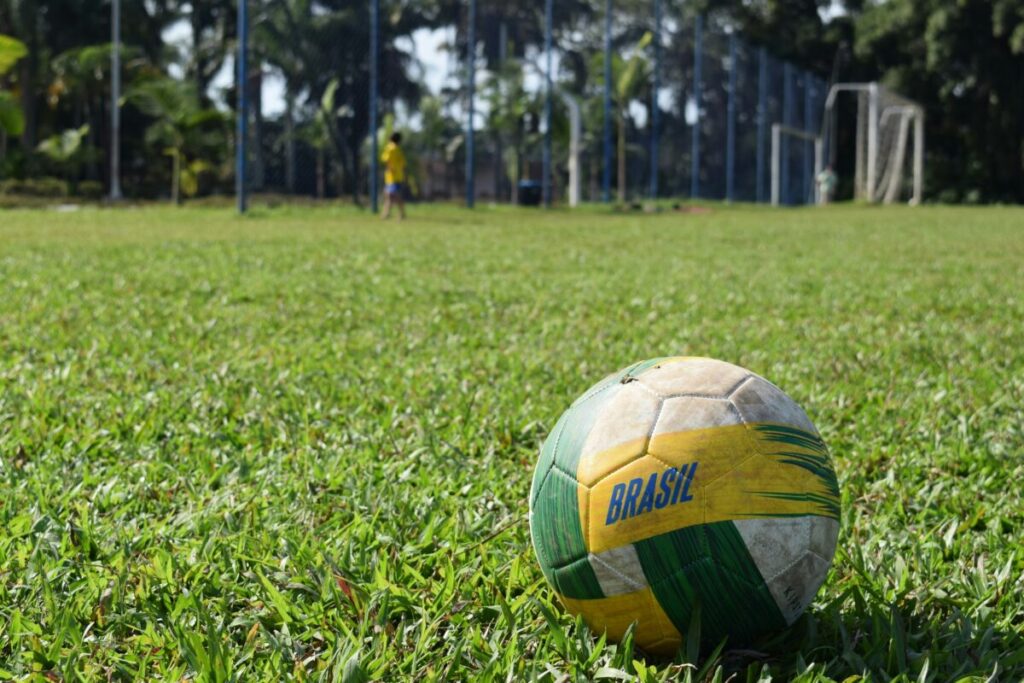
A country that built a style of play around beauty, not just results, is saying something about its values. And about its contradictions too.
Brazil is the country of the most beautiful football — and also the country that has suffered some of the most painful defeats in the sport’s history. In 1950, at the Maracanã. In 2014, at the Mineirão. Both losses share the same flaw: a team that forgot beauty and efficiency have to coexist.
But after every defeat, Brazil comes back playing the same way. Not out of stubbornness or mistake — because it’s the only way of playing that makes sense to Brazilians.
The ginga, the dribble, the unnecessary heel flick late in the afternoon during an empty kickabout on a dirt field or on one of those famous beaches the whole world has heard of — these are the same tools Brazilians use to navigate a country that almost never offers a straight path either. It’s improvisation with precision. Creativity as a method of survival.
You can’t teach this in a football academy. It’s born in the street, in scarcity, in the game that happens even when it probably shouldn’t.
That’s why Brazil plays differently. And that’s why the rest of the world never stops watching.