
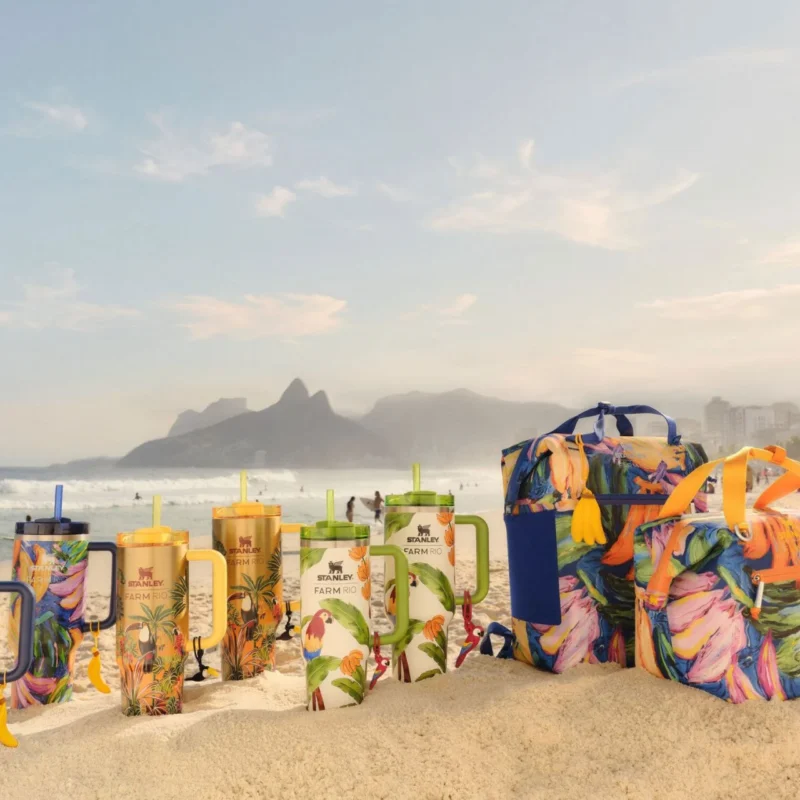
FARM Rio, the Rio de Janeiro label that made its name turning banana leaves and beach light into wearable prints, has done it again — this time on a Stanley 1913 Quencher, the 40-ounce tumbler that has somehow become one of the most recognizable objects in America. The result is less a product drop than a mood transplant: tropical foliage, native birds and FARM Rio’s signature oversized banana print, stretched across the curves of a cup that usually comes in solid, gym-bag colors.
The collection spans three prints — Tropical Destiny, Tropical Woods and Painted Banana — applied to the 40 oz. and 30 oz. Quenchers ($65 and $55), plus the Julienne Mini Cooler ($140) and the Madeleine Mini Cooler Backpack ($155) in Painted Banana. Each piece comes with its own charm dangling off the handle: a tiny bunch of yellow bananas, or a small tropical bird, depending on the print. It’s a detail that feels distinctly FARM Rio — the brand rarely does a collaboration without slipping in something playful and slightly unnecessary, in the best way.
This isn’t the label’s first move outside the closet. FARM Rio has spent the last few years proving that its visual language travels well beyond clothing — from a home collection with Anthropologie that put banana-motif pitchers and leaf-edged napkins on American dinner tables, to outerwear, accessories and now drinkware. Each version follows the same logic: take an object Americans already own — a tote, a rug, a raincoat, a water bottle — and hand it a Brazilian point of view.
What makes the Stanley collaboration land differently is the object itself. The Quencher isn’t a niche fashion item; it’s a mass-market status symbol, the thing people line up for and stack by the dozen in cabinet videos. Putting FARM Rio’s prints on it isn’t just a licensing deal — it’s a bet that “Brazilian” now reads as desirable shorthand to an audience that has never set foot in Rio de Janeiro, the same way “French girl” or “Scandinavian minimalism” have functioned as aesthetic categories for years.
Founder Kátia Barros, who started FARM Rio at a market stall in Rio in 1997 before building it into one of Brazil’s most recognized fashion exports, described the collaboration as a shared language: “The Stanley 1913 and FARM Rio capsule captures the joy, optimism, and love of color that defines both of our brands.” Stanley’s chief brand officer, Kate Ridley, put it in terms closer to the brand’s own vocabulary, calling it a lesson in “unabashed self-expression” borrowed from FARM Rio.
It’s a small thing, a tumbler. But it’s also a fairly precise snapshot of how Brazilian design is being absorbed into American everyday life right now — not through a single grand gesture, but object by object, cabinet by cabinet, until color and print stop reading as “exotic” and start reading as simply desirable.