
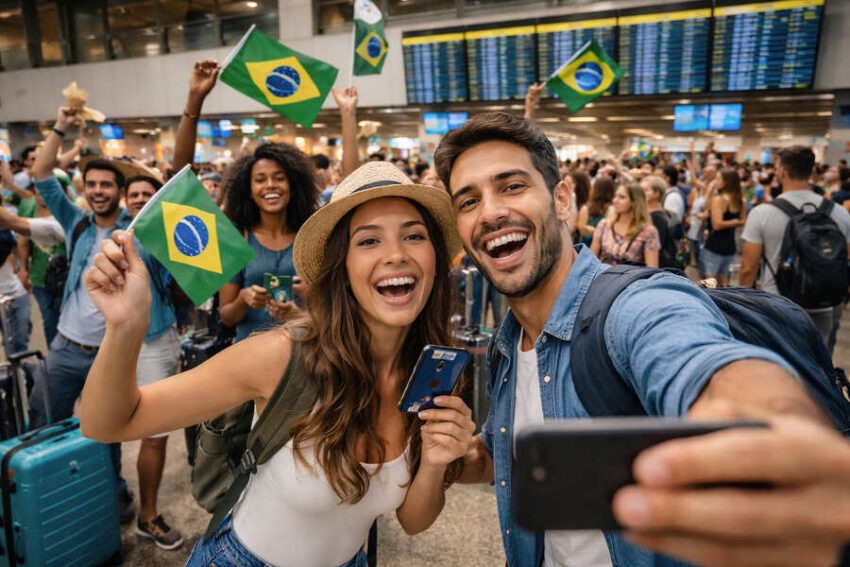
While Brazil continues to register historic growth in international arrivals, 2026 marks a defining shift in global tourism: the Brazilian traveler has become one of the most desired and economically relevant tourist profiles worldwide.
Brazil is no longer just a destination. It is both a magnet for international visitors and a powerful source of outbound demand shaping travel flows across continents.
A Strong Domestic Tourism Cycle — With Global Impact
Brazil recorded 9.29 million international arrivals, the highest volume ever observed in its historical series, according to the Ministry of Tourism. Foreign visitor spending reached US$ 7.8 billion, setting a new record and confirming the country’s growing economic relevance in the global tourism ecosystem.
Nearly three thousand international flights landed in Brazilian territory during the measured period — a clear sign of strengthened air connectivity and renewed international confidence.
But the story does not stop at inbound growth.
The Rise of the Brazilian Tourist Abroad
Brazil’s outbound tourism has reached historic levels. In 2024 alone, Brazilians made 9.5 million international trips, and official data entering 2025 indicated continued strong momentum.
According to Brazil’s Central Bank, expenditures by Brazilians overseas totaled US$ 21.7 billion in 2025, the highest level in 11 years.
This expansion occurred amid increased economic activity, rising income levels, expanded international routes, and a favorable currency environment. In 2025, the U.S. dollar declined 11.18% against the Brazilian real — reducing costs for airfare, hotels, and international purchases.
The profile of the Brazilian traveler has evolved significantly. Today, this segment is associated with:
- Longer stays
- Higher per-capita spending
- Luxury and premium upgrades
- Multi-country European itineraries
- Cultural immersion and experiential travel
Europe, the United States, and the Caribbean remain among the most sought-after regions. Countries such as France, Italy, Spain, Switzerland, Japan, South Korea, and the United Arab Emirates increasingly recognize Brazil as a high-value source market.
Visa-Free Access to 168 Countries Expands Brazil’s Reach
In February 2026, Brazil strengthened its global mobility footprint by granting citizens visa-free or simplified access to 168 countries.
The expansion spans all major regions:
- Europe: including France, Germany, Portugal, Spain, Italy, and the United Kingdom
- Asia: including Japan, South Korea, Singapore, China, and the UAE
- The Americas & Caribbean: including Argentina, Chile, Colombia, Peru, and multiple island nations
- Africa: including South Africa, Kenya, Seychelles, and Morocco
Greater mobility reduces barriers, encourages spontaneous travel, and reinforces Brazil’s position as one of the most globally connected emerging travel markets.
For international destinations, this development translates into easier access to a traveler segment known for engagement, cultural curiosity, and strong purchasing power.
International Confidence in Brazil Continues to Grow
As Brazilians expand their global presence, international visitors continue choosing Brazil at record levels.
The country’s appeal extends beyond traditional beach tourism. Biodiversity travel in the Amazon, luxury hospitality in Bahia, wine routes in the South, and urban cultural circuits in São Paulo and Rio de Janeiro are reshaping the perception of Brazil as a multidimensional destination.
Foreign visitor spending reaching historic highs confirms that Brazil’s tourism growth is not only about volume — it is about economic impact and diversified experiences.
A Two-Way Tourism Influence
What defines Brazil in 2026 is not merely expansion, but balance.
Few markets simultaneously combine:
- Record inbound arrivals
- Record outbound spending
- Expanded visa-free mobility
- Strengthened currency conditions
- And growing global cultural visibility
Brazil is operating as a mature tourism market — both receiving and generating high-value travelers.
For international travelers, Brazil represents scale, diversity, and cultural depth.
For global destinations, Brazilian tourists represent one of the most dynamic and desirable source markets in the world.
In 2026, Brazil is not simply participating in global tourism — it is influencing it from both sides.