
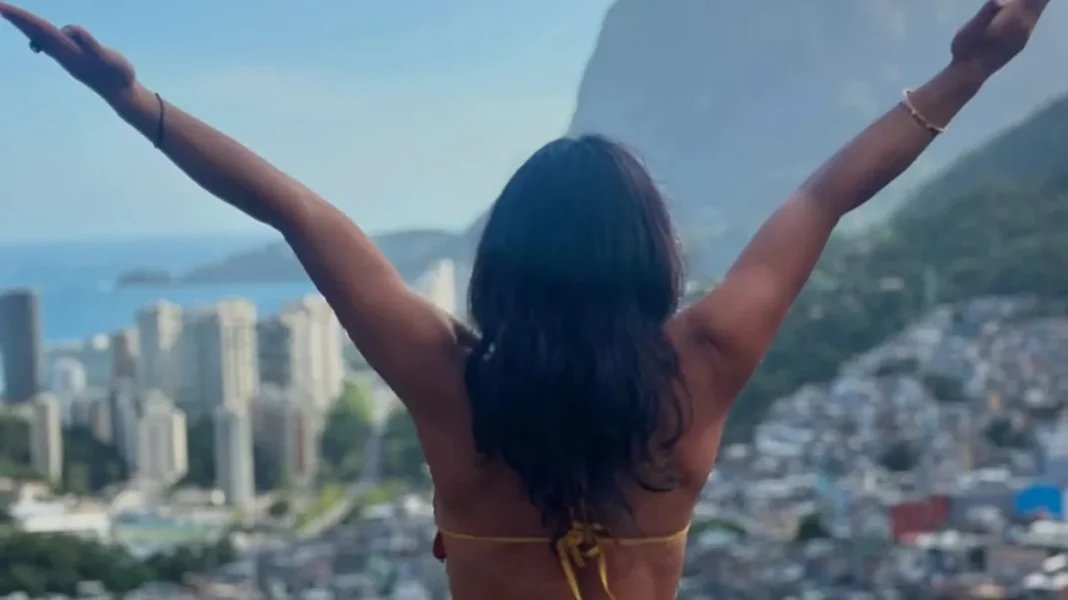
A social media-driven tourism trend emerging from Rio de Janeiro is drawing growing attention from international media. Known as the Rocinha Trend, the phenomenon centers on tourists visiting rooftops in Rocinha — the largest favela in Brazil — to record drone-shot videos that capture sweeping aerial views of the community alongside Rio’s coastline.
The movement has recently been spotlighted by global outlets, including a report by The Guardian, which highlighted how these rooftop experiences have quickly become one of the city’s most talked-about attractions.
The experience typically involves visitors walking or posing on terraces while drones pull back to reveal the scale of the favela against Rio’s iconic landscape. The resulting videos have gained millions of views across platforms, transforming specific rooftops into viral destinations.
One of the most visited locations is the “Porta do Céu” (Gateway to Heaven), a terrace that has seen a surge in visitors since 2025, when drone videos filmed there began circulating widely online. According to local guides interviewed by The Guardian, some of these videos reached tens of millions of views, accelerating the visibility of the trend.
As a result, demand has increased significantly. Reports indicate that long queues have formed at the site, with wait times reaching up to two hours. Visitors from different parts of the world — including Europe, Asia and across Latin America — are now incorporating Rocinha into their Rio itineraries, alongside traditional landmarks such as Christ the Redeemer and Copacabana.
The rise in tourism is also generating economic activity within the community. Local guides, drone operators and residents who provide access to rooftops are directly benefiting from the influx of visitors. In interviews featured in the international coverage, young residents working as drone operators described filming dozens of videos per day, reflecting the scale and consistency of demand.
Structured tours have also become part of the experience, often including guided walks through the favela, contact with local artists and cultural expressions such as capoeira. Organizers involved in the initiative state that one of the objectives is to broaden perceptions of favela life and present aspects of culture, creativity and daily routines that are not always visible in mainstream narratives.
At the same time, the trend has prompted debate. Critics argue that the visual framing of the videos may simplify complex social realities, while others point to longstanding discussions around favela tourism and representation.
Supporters, on the other hand, highlight the economic opportunities and the fact that many of these initiatives are led by residents themselves. Testimonies reported in international coverage suggest that tourism linked to the trend has created new sources of income and professional paths for locals.
The Rocinha Trend illustrates how social media continues to reshape travel behavior and global perceptions, turning previously overlooked urban spaces into international points of interest while raising broader questions about visibility, narrative and impact.