
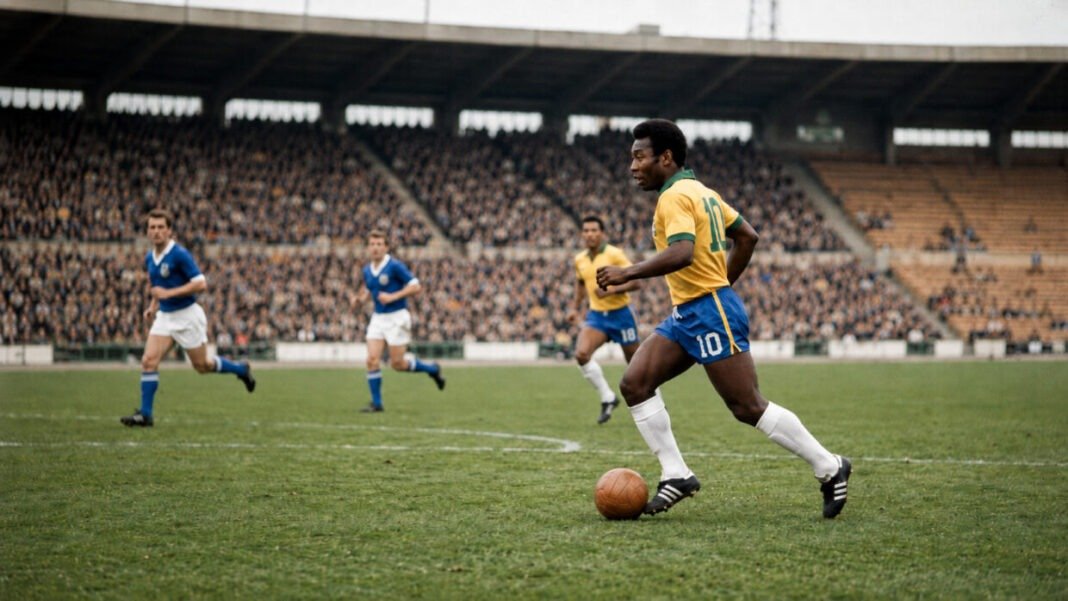
Before Pelé, Brazil had talent. After him, it had presence.
In 1958, a seventeen-year-old from the countryside of Minas Gerais cried on the pitch in Stockholm as Brazil won its first World Cup. Pelé had scored twice in the final, but what stayed with the world wasn’t just the victory—it was the image of a young Black Brazilian, overwhelmed, collapsing into the arms of his teammate, as if the moment carried more weight than celebration alone.
That image traveled not simply because Brazil had won, but because it revealed something rarely seen at the time: a country expressed through emotion, through youth, through someone who clearly came from far beyond the traditional centers of power. For many watching, it was one of the first encounters with Brazil that felt real rather than constructed. And for Brazil, it felt like recognition.
Pelé didn’t just win a title. He shifted perception.
From the margins to the center of the world
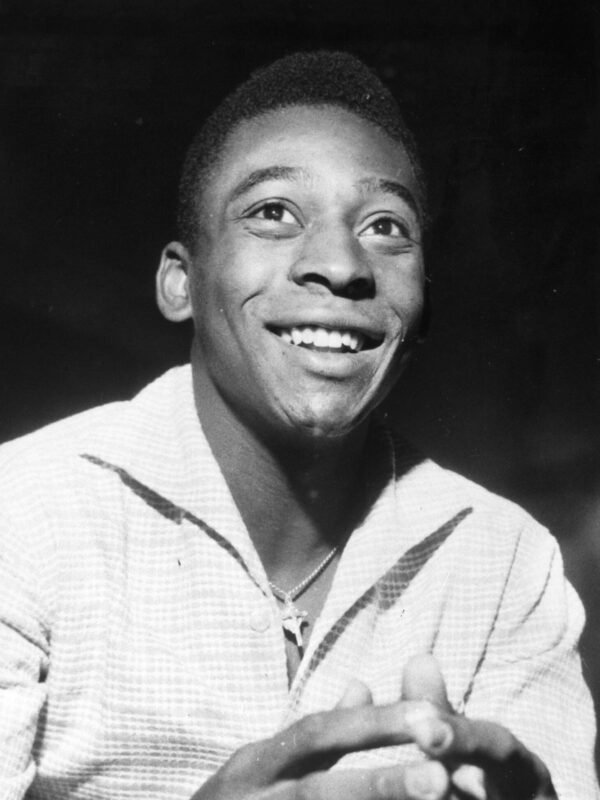
Edson Arantes do Nascimento was born in Três Corações, a small town in Minas Gerais, far from any global stage. His father had been a footballer whose career ended early, and his mother distrusted the sport after seeing what it had taken from the family. Pelé grew up polishing shoes and training with improvised balls, in a reality where talent alone rarely translated into opportunity.
Which is precisely why his rise resonated far beyond football.
By the time he was twenty, he was already among the most recognized athletes in the world. Not long after, he became something even rarer: a global cultural figure whose identity was inseparable from the country he came from. A Black Brazilian man, from a working-class background, elevated to the title of “The King” in rooms where few like him had ever been invited—not metaphorically, but in a very literal sense.
Pelé moved through spaces that extended far beyond sport. He met presidents and royalty, appeared on the cover of Time, and became a presence in conversations that had little to do with football itself. In an era before global celebrity operated at scale, his visibility already functioned that way. Stories like the often-cited pause in the Nigerian Civil War so both sides could watch him play endure not for their precision, but for what they suggest about his reach.
More than football—an image of Brazil
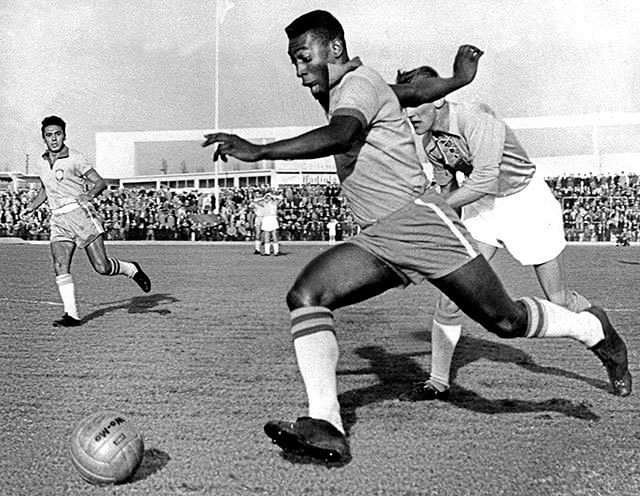
To understand Pelé’s impact is also to understand Brazil at that moment in time. The country was expanding, modernizing, projecting ambition through projects like Brasília, while still navigating how it was perceived abroad—often reduced to caricature, distance, or condescension.
Pelé complicated that image.
Through him, Brazil became associated not only with skill, but with a kind of creative intelligence—improvisation without chaos, joy under pressure, elegance without rigidity. The 1970 World Cup made that visible in its most complete form, with a team that played in a way that still feels studied today. Pelé was at the center of it, not just as a scorer, but as a conductor of rhythm, helping define a style that would become inseparable from how the world understands Brazilian excellence.
Global fame, before globalization
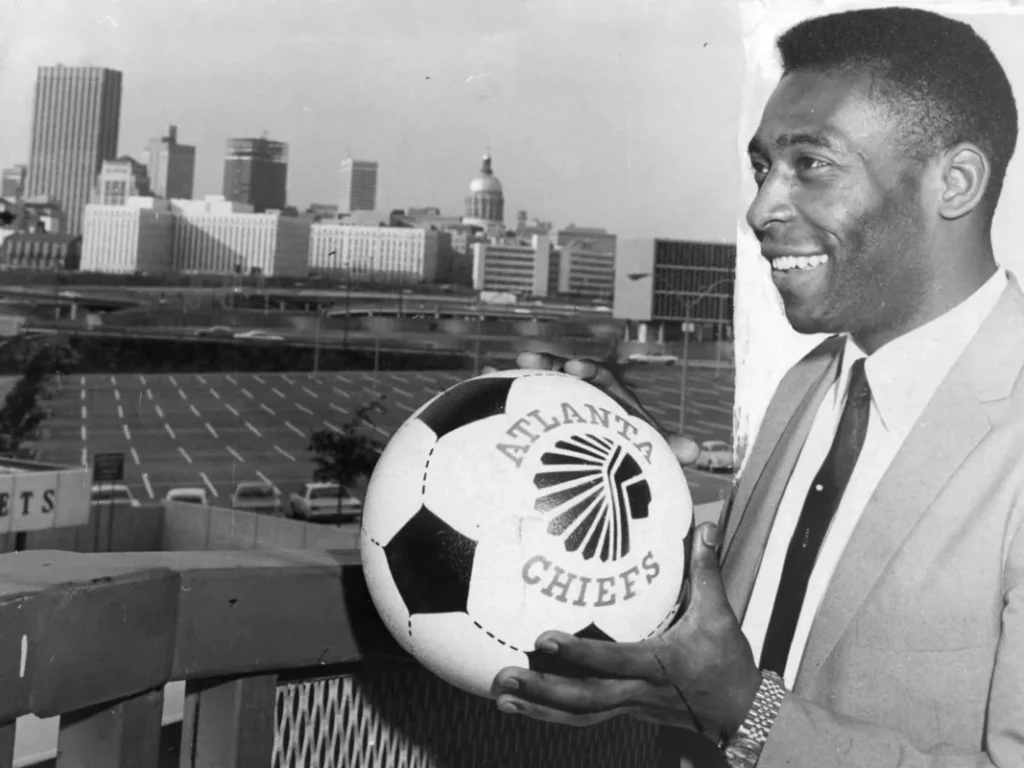
By the late 1960s, Pelé was no longer just a footballer—he was one of the most recognized people in the world. His presence crossed industries and geographies, placing Brazil into conversations it had rarely entered on its own terms.
Santos FC’s international tours became more than sporting events; they were a kind of cultural introduction. In many places, Pelé was not just representing Brazil — he was Brazil. During tours across the United States, Santos faced teams like the Atlanta Chiefs, drawing crowds that treated the matches less like exhibitions and more like rare encounters with a global phenomenon. In a 1968 match at Atlanta-Fulton County Stadium, Pelé scored a hat trick in a 6–2 victory before a packed audience, reinforcing the sense that his presence alone could transform how Americans experienced both football and Brazil itself.
In many places, Pelé was not just representing Brazil—he was Brazil. His later move to the New York Cosmos extended that visibility into the United States at a time when soccer had little cultural relevance there. His arrival drew attention that the sport had never managed to capture, filling stadiums and creating a brief but meaningful shift in how the game—and the country behind it—were perceived.
Contradictions, visibility, and legacy
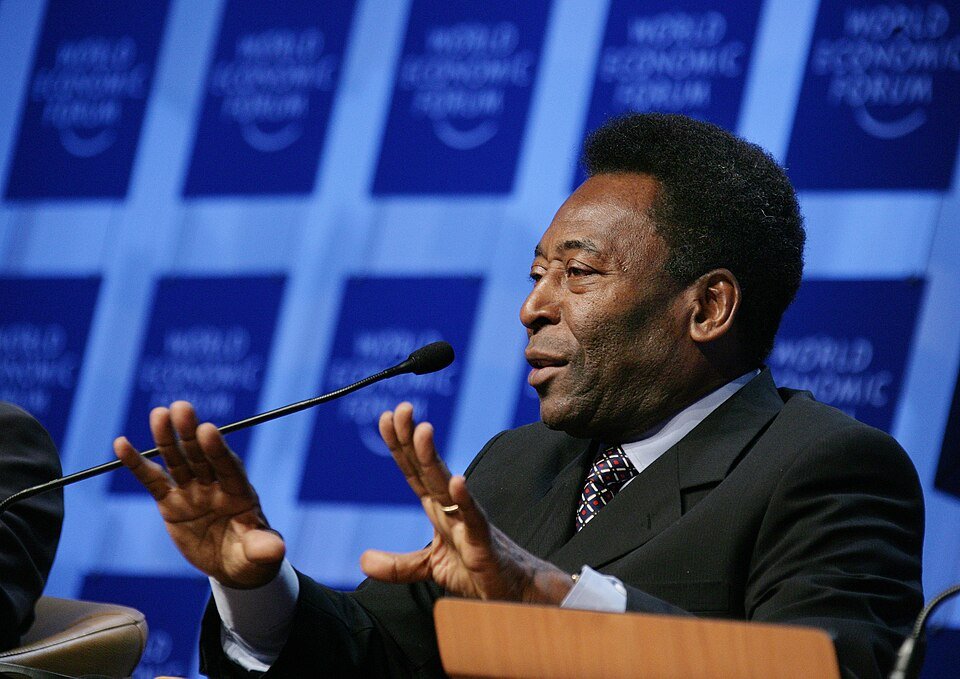
Like any figure operating at that scale, Pelé’s story carries contradictions. During Brazil’s military dictatorship, his image was used in ways that aligned with national narratives, and his silence on political matters drew criticism that remains part of his legacy. Yet even within that complexity, his symbolic impact holds.
For many Brazilians, especially those from backgrounds similar to his, Pelé represented something deeply personal: not a promise, but a possibility. A sense that visibility, recognition, and excellence were not confined to where you were born or what you had access to.
The last image
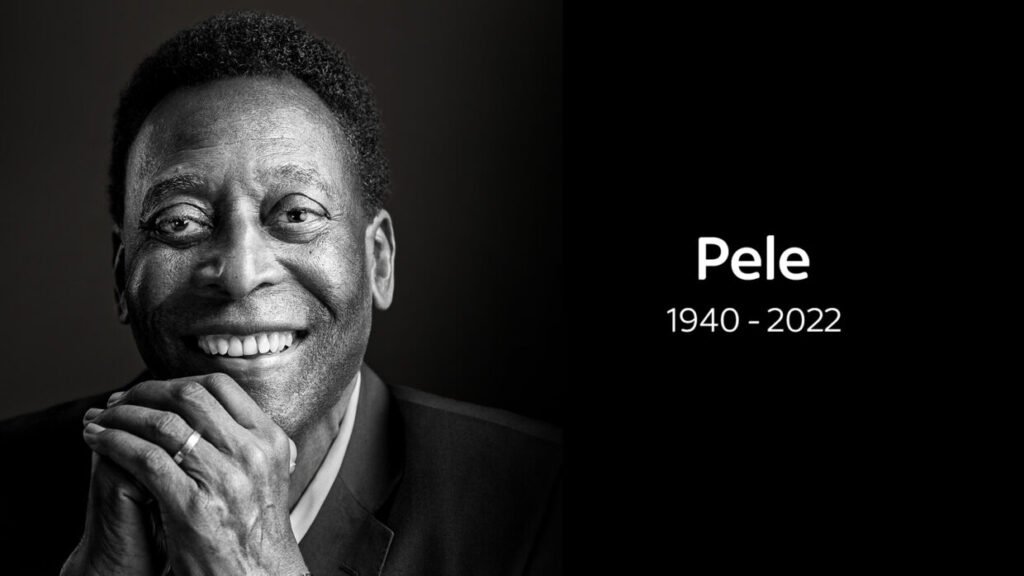
When Pelé died in 2022, the response was immediate and global, extending far beyond football. Heads of state, artists, and athletes marked his passing, while in Brazil, thousands lined up to say goodbye in a gesture that felt as much about identity as it did about memory.
What they were mourning was not just a player, but a moment when the country saw itself differently—and realized that the world was seeing it too.
Pelé didn’t invent that shift. But he made it visible.
Not just to the football—but to what could emerge from a place like Brazil.

