
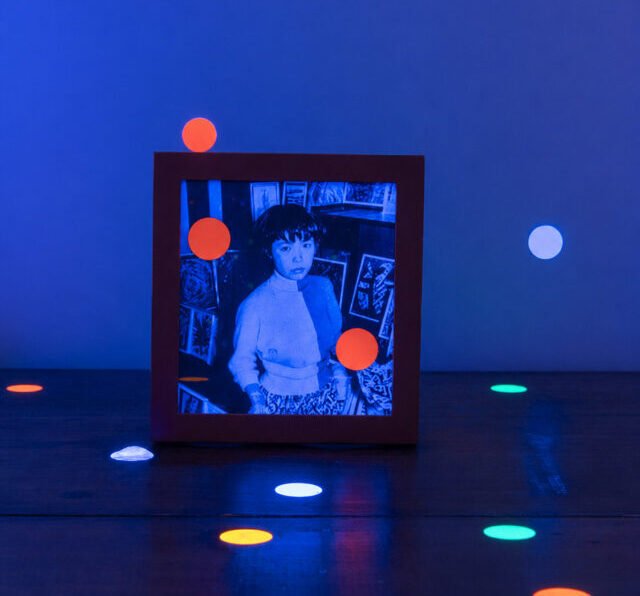
Yayoi Kusama died on August 14, 2026, in a Tokyo hospital at 97, closing a career that stretched from postwar avant-garde New York to a market that, in 2022, paid $10.5 million for a single one of her paintings at auction. In Brazil, her work isn’t a memory to revisit through old exhibition photos. It’s a building you can still walk into.
Since 2023, Instituto Inhotim in Brumadinho, Minas Gerais, has housed a permanent gallery dedicated entirely to Kusama — one of only a handful of spaces in the world built around her work alone, and the only one in Latin America.
A gallery built for one artist
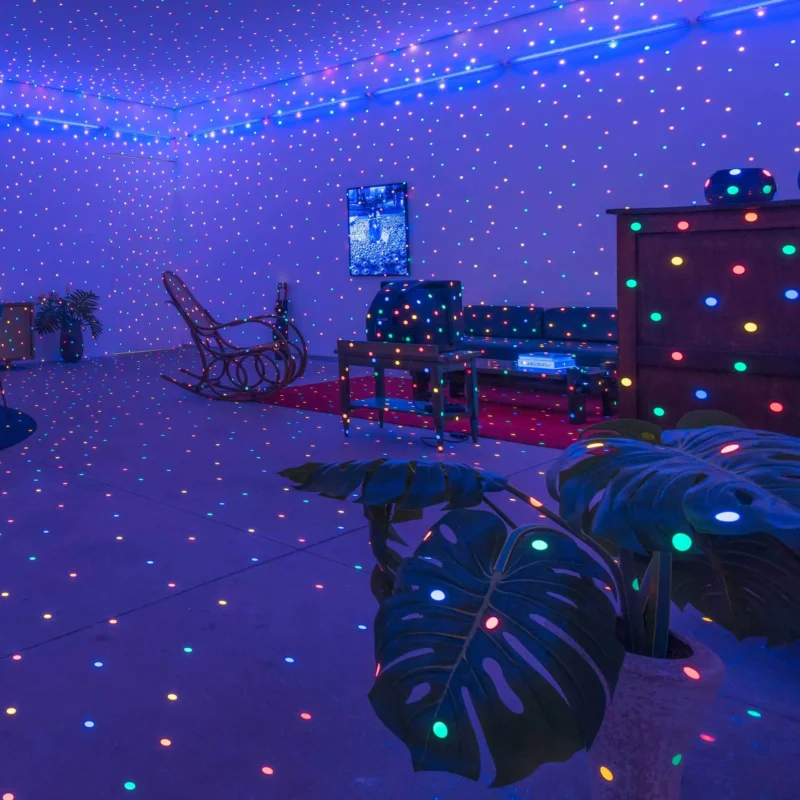
The Galeria Yayoi Kusama was originally planned to open in 2020, delayed for years before its 2023 debut. At 1,437 square meters (roughly 15,500 square feet), it’s the 20th gallery on Inhotim’s campus, sited in the institute’s Orange Axis near the Cosmococa Gallery and the Veredas Garden. Architects Fernando Maculan and Maria Paz designed the building with an oversized planted entrance and canopy — a deliberate response, Inhotim has said, to how large the crowds drawn by Kusama’s work tend to be.
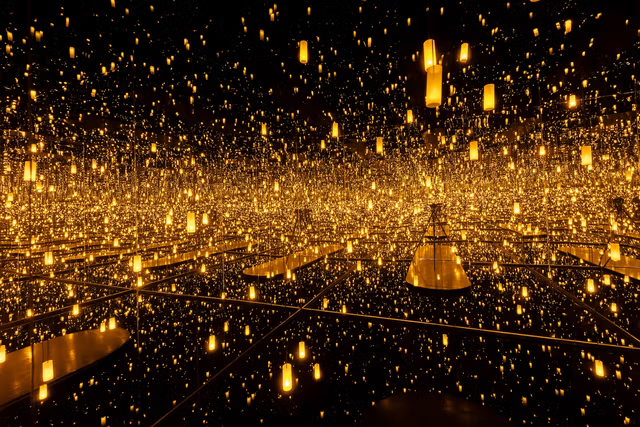
Inside are two immersive environments. I’m Here, But Nothing (2000), acquired by Inhotim in 2008, recreates a domestic living room — furniture, household objects, walls — covered edge to edge in fluorescent dot stickers and lit under black light, so the room appears to dissolve into floating points of color. Aftermath of Obliteration of Eternity (2009), acquired the following year, is an infinity mirror room strung with suspended, glowing lanterns; Inhotim frames it as a meditation on the fleetingness of life. Inhotim co-founder Allan Schwartzman has described the pairing as engineering “optical transformation” and “contemplative infinity” — mirrors that multiply a handful of physical lights into what reads as an endless field.
The gesture at Venice that made her a legend
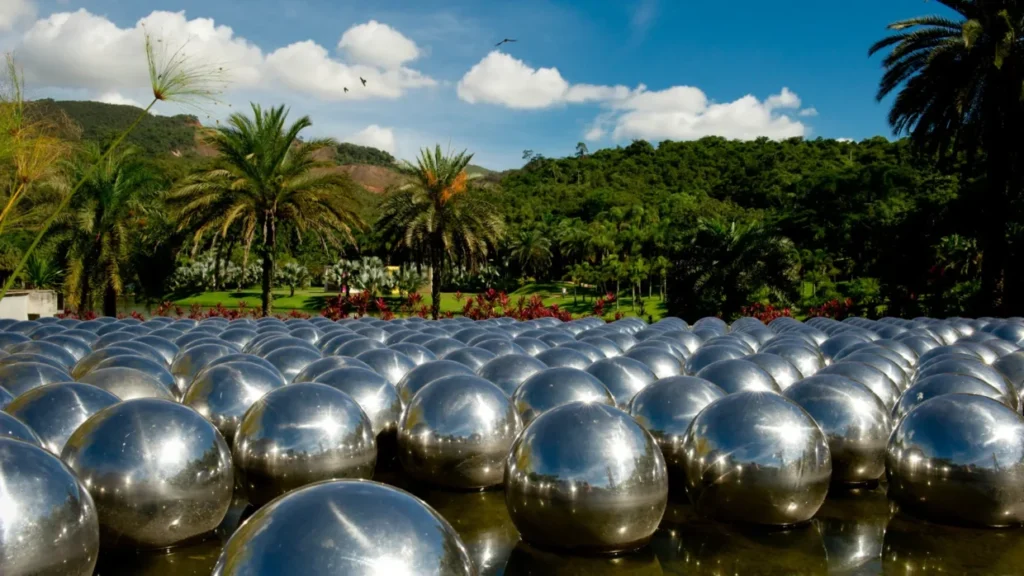
The gallery’s third work isn’t inside it at all. In the Pink Axis, in the open air, Inhotim shows Narcissus Garden (1966/2009) — a field of mirrored spheres scattered across a lawn. The piece restages one of the most audacious things Kusama ever did.
At the 1966 Venice Biennale, Kusama wasn’t an invited artist. She showed up anyway, spread 1,500 mirrored spheres across the grass in front of the Italian pavilion, and started selling them one by one for 1,200 lire — about $2 each — standing beside a sign that read “Your Narcissism for Sale.” Biennale officials shut the sale down, reportedly because an uninvited artist hawking work like a street vendor offended the event’s decorum. Kusama had turned self-reflection into a commodity and the art establishment into her subject, and got shut down for it — a gesture now read as one of the earliest and most prescient critiques of the contemporary art market’s own theater. The version on Inhotim’s lawn, restaged in 2009, lets visitors have the encounter Venice officials cut short: walking among the spheres, seeing themselves fractured and multiplied across the grounds.
Before the gallery: the tour that introduced Kusama to Brazil at scale
Inhotim’s gallery wasn’t Brazilians’ first encounter with Kusama’s work. Between 2013 and 2014, the traveling exhibition Obsessão Infinita (Infinite Obsession) brought roughly 100 works spanning 1949 to 2012 — paintings, sculptures and her immersive installations — to CCBB Rio de Janeiro, CCBB Brasília and Instituto Tomie Ohtake in São Paulo. The tour drew more than 2 million visitors nationally, and the Brasília leg set an attendance record for the venue. It was, at the time, one of the clearest signals that Kusama’s work — built around obsessive repetition, self-obliteration and hallucinatory pattern, themes she traced back to visual and auditory hallucinations she experienced as a child in Matsumoto, Japan — connected with audiences well beyond the contemporary-art circuit that first embraced her in 1960s New York.
That international standing was already well established by then: Kusama was the first artist to represent Japan alone at the Venice Biennale, in 1993, and received the Asahi Prize for cultural contribution in 2001. She later collaborated with Louis Vuitton on collections that put her polka dots on handbags and storefronts worldwide.
What to know if you want to see her work in Brazil
Both pieces are permanent installations at Instituto Inhotim, in Brumadinho, about an hour outside Belo Horizonte: the Galeria Yayoi Kusama in the Orange Axis, and Narcissus Garden outdoors in the Pink Axis. Because of visitor volume, Inhotim uses timed, limited-capacity entry for the gallery — check current visitation rules and book a time slot on Inhotim’s website before you go, ideally in advance during peak season.